
Purchasing Carbon Credits: A Strategic Guide
Purchasing Carbon Credits: A Strategic Guide
Navigating the voluntary carbon market to purchase carbon credits for your organisation requires a strategic and informed approach. Carbon credits, when used responsibly and chosen carefully, can be a valuable tool to address residual emissions and contribute to global climate goals. However, the market is complex, with varying quality and impact among projects.
This guide outlines key factors to consider when choosing which carbon credits to buy, ensuring your investments are effective, credible, and aligned with your broader sustainability objectives.
1. Prioritise Emissions Reduction First
It is crucial to understand that carbon credits are a complementary tool, not a substitute, for direct emissions reductions within your own operations and value chain. Leading climate frameworks, such as the Science Based Targets initiative (SBTi), advocate for a "mitigation hierarchy." This means companies should first strive to reduce their emissions as much as possible, in line with a 1.5°C pathway, before considering offsets for the truly unavoidable residual emissions. However, with time in which to act running dangerously short, many are saying that any action now beat perfect action in the future and that a robust decarbonisation plan can be strengthened with the retirement of high-integrity credits.
2. Understanding Carbon Neutral vs. Net Zero
The terms "carbon neutral" and "net zero" are often used interchangeably but have distinct definitions, particularly regarding the role of carbon credits:
• Carbon Neutral: This means purchasing carbon reduction credits equivalent to the emissions released, without a specified requirement for prior emissions reductions. It involves measuring emissions, setting a plan for reduction, and then offsetting the total sum with carbon credits, often following the international standard PAS 2060. Critics argue that carbon neutrality, on its own, does not sufficiently incentivize the deep, transformative emission reductions needed to limit global warming to 1.5°C, and can be seen as "greenwashing" if not accompanied by robust internal reductions. Carbon neutrality typically covers direct (Scope 1 and 2) emissions, with optional additions for indirect (Scope 3) emissions.
• Net Zero: This is a more ambitious and comprehensive strategy. It requires businesses to achieve substantial (typically 90%) emissions reductions across their entire value chain (Scope 1, 2, and 3 emissions) in line with the latest climate science, usually by 2050. Any remaining "hard-to-decarbonize" residual emissions must then be balanced only through high-quality carbon removal credits. The SBTi Corporate Net-Zero Standard provides a global framework for companies to set these science-based targets, aligning efforts with the critical 1.5°C global warming limit. Net zero mandates a holistic, organization-wide approach to decarbonization, emphasizing direct emission reductions as the primary focus.
3. Avoidance vs. Removal Credits
Carbon credits represent a claim to either avoided greenhouse gas (GHG) emissions or enhanced GHG removals. Understanding this distinction is crucial for a credible climate strategy:
• Avoidance Credits: These credits come from projects that prevent future greenhouse gas emissions from entering the atmosphere. Examples include renewable energy development (displacing fossil fuels), methane capture and destruction (e.g., from landfills), and avoided deforestation (REDD+). While valuable, avoidance credits face scrutiny regarding their additionality and the inherent uncertainty in measuring hypothetical avoided emissions. During the decarbonisation journey toward net zero, high-integrity avoidance credits may support interim carbon neutrality goals, before transitioning to carbon removal credits once deep emissions reductions have been achieved.
• Removal Credits: These credits originate from projects that actively extract carbon dioxide directly from the atmosphere and store it, thus reducing its concentration. They are considered essential for addressing historical emissions and neutralizing unavoidable residual emissions, particularly for achieving net-zero targets. Examples include afforestation/reforestation, bioenergy with carbon capture and storage (BECCS), direct air carbon capture and storage (DAC+S), enhanced weathering, blue carbon (coastal ecosystems like mangroves), and soil carbon sequestration. Removal credits are generally more expensive due to the technologies and long-term commitment involved.
A selection of high-integrity avoidance and removal credits can be viewed and compared at Carbon Compared (carboncompared.com).
4. Credit Quality and Integrity
The effectiveness and credibility of carbon credits depend heavily on their "integrity" or "quality", meaning they represent genuine, measurable, permanent, and additional emissions reductions or removals without causing harm.
• Certification and Standards: Only purchase credits certified by established and reputable carbon crediting programs that adhere to rigorous standards. Examples of such programs include Verra (Verified Carbon Standard - VCS), Gold Standard, American Carbon Registry (ACR), and Climate Action Reserve (CAR). These programs develop and approve standards, review projects, and operate registries that issue, transfer, and retire credits.
• Integrity Council for the Voluntary Carbon Market (IC-VCM) and Core Carbon Principles (CCPs): The IC-VCM is establishing a global benchmark for "high-integrity" carbon credits through its Core Carbon Principles (CCPs). Credits can only be tagged with the CCP label if both the crediting program is approved as "CCP-Eligible" and the project's methodologies are "CCP-Approved". As of June 2024, seven methodologies have been approved for CCP-labeling, focusing on capturing and destroying potent GHGs like ozone-depleting substances (ODS) and landfill methane, provided specific conditions are met. More categories are under assessment.
• Independent Rating Agencies: Given the complexity of assessing quality, consider consulting independent third-party carbon credit rating agencies such as BeZero Carbon, Sylvera, Calyx Global, and Renoster. These agencies provide detailed, project-level assessments across multiple criteria like additionality, permanence, quantification, and leakage risks. While their ratings for the same projects can differ, they offer valuable insights beyond a binary pass/fail. You can view the BeZero Carbon Rating of various projects for free at Carbon Compared to help you make the most informed decision when selecting a project.
5. Key Quality Criteria in Detail
When evaluating individual projects or credits, delve into these essential elements of quality:
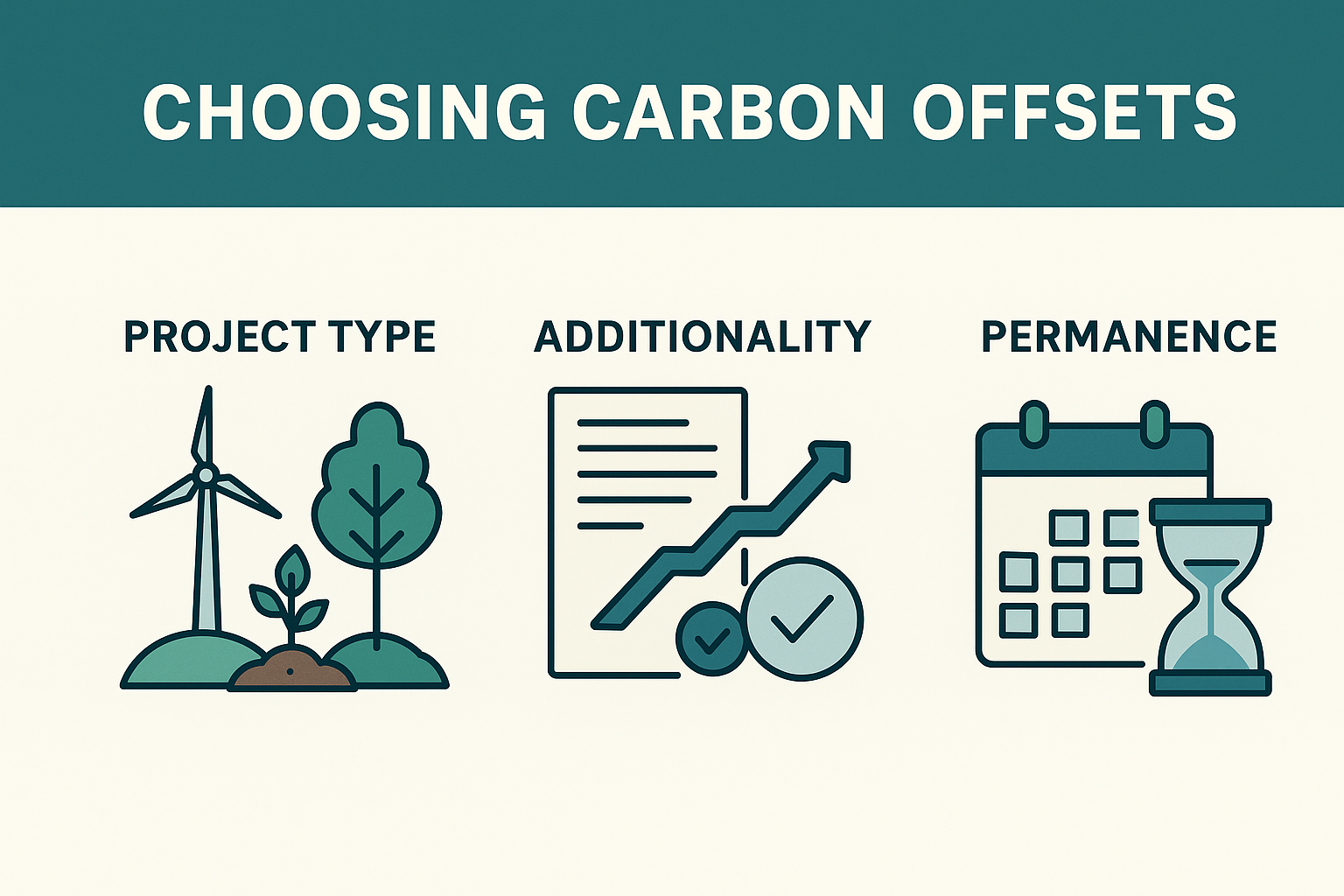
• Additionality: This is fundamental. An additional project is one that would not have occurred without the incentive provided by carbon credit revenues. If a project would have happened anyway (e.g., due to legal requirements or profitability), its credits do not represent a genuine climate benefit. Evaluating additionality can be difficult, as it involves comparing to a hypothetical scenario. Projects like industrial gas destruction often have clear additionality, while many renewable energy projects or those with high non-carbon revenues require careful scrutiny. Independent studies have raised concerns about the additionality of a significant portion of past carbon credits.
• Permanence / Durability: This refers to the long-term sustainability of the avoided emissions or carbon sequestration. For carbon stored in trees or soils, there's a risk of "reversal" (carbon being released back into the atmosphere due to wildfires, disease, or human activity). To address this, most crediting programs use "buffer reserves," where a portion of credits from projects with reversal risk are set aside as an insurance mechanism. While a 100-year permanence period is a common convention, scientifically, "permanent" means hundreds to thousands of years to truly compensate for CO2's long atmospheric lifetime. Buyers should be aware of these risks, especially for nature-based projects.
• Avoiding Overestimation (Quantification & Leakage): This means the quantified GHG emissions avoided or removals enhanced are conservative relative to a realistic baseline. Overestimation can occur by inflating baseline emissions, underestimating actual project emissions, or failing to account for "leakage". Leakage happens if the project causes emissions to increase elsewhere (e.g., protecting one forest area leads to deforestation in another). Rigorous monitoring, third-party verification, and scientifically sound methods are required to prevent overestimation.
• Exclusive Claims (No Double Counting): Carbon credits must convey an exclusive claim to the avoided emissions or enhanced removals and not be counted or used more than once. Double counting can occur through: ◦ Double issuance: More than one credit issued for the same avoided tonne. ◦ Double use: Two different parties counting the same credit towards their goals. ◦ Double claiming: The project's mitigation is also claimed by a government or another entity. Crediting programs use unique serial numbers in registries to track credits and prevent double counting. Buyers should confirm the purpose and beneficiary of retirement are publicly recorded.
• Avoiding Social and Environmental Harms and Co-benefits: Projects should not only deliver climate benefits but also avoid causing (new) social and environmental harms. Many projects offer positive "co-benefits" beyond carbon, such as improved community employment, enhanced air/water quality, biodiversity conservation, and better access to health/education services. Projects should comply with legal requirements and conduct local stakeholder consultations. Some programs, like Gold Standard, actively require projects to demonstrate co-benefits. While projects with high co-benefits may correspond with higher credit prices, some project types with lower quality risks (e.g., industrial gas destruction) tend to have fewer co-benefits, creating a trade-off. Independent rating agencies often assess co-benefits, sometimes as a separate score.
6. Project Lifecycle and Timing
• Ready-to-Retire (Ex-post) Credits vs. Pre-issuance (Ex-ante) Credits :
Ex-post credits are issued after avoided emissions or enhanced removals have already occurred and been verified. These are "ready to retire" credits otherwise known as "spot credits".
Ex-ante credits are issued for avoided emissions or removals that a project developer expects to achieve in the future. Purchasing these credits allows early investment in projects, potentially at a lower price, and can help scale new technologies (especially removals). However, ex-ante purchases carry delivery risk – the risk that the promised reductions/removals might not materialize. Independent ratings can help de-risk these investments.
• Vintage Year: The "vintage" refers to the year a credit was issued or when its associated emissions reductions/removals occurred. Older vintages may raise quality concerns if they have remained unsold for a long time and the project continued without credit revenue, as it might suggest a weak case for additionality. However, the vintage itself does not inherently indicate quality.
7. Local Factors and Geography
The geographic location of a carbon project can influence its effectiveness, co-benefits, and associated risks. Projects in developing countries may offer significant social benefits like job creation, but might also face unique regulatory and operational challenges. Projects located in Least Developed Countries (LDCs) often have higher additionality and co-benefits, while those in high-income countries may score better on quantification, permanence, and legal/ethical aspects. Understanding the regional context helps ensure a project's sustainability and compliance with local needs.
8. Portfolio Diversification
Like financial investments, building a diverse portfolio of carbon credits can help mitigate risk and achieve a broader range of climate and social impacts. This can involve mixing different project types (nature-based vs. technology-based), a combination of removal and avoidance projects, and even a mix of longer and shorter-term credits. A robust portfolio helps safeguard against the dynamic nature of voluntary carbon markets and minimizes reputational and climate risk.
9. Transparency in Communication
Transparent communication about your carbon credit use is paramount to maintaining credibility and avoiding "greenwashing" accusations. Clearly communicate your primary focus on internal emissions reduction efforts, providing factual evidence of these achievements. Then, explain how carbon credits are being used to address residual emissions, specifying the projects you support and their expected impact. Experts increasingly advise using terms like "contribution" rather than "offsetting" or "compensating" to avoid misleading claims, particularly if you cannot demonstrate full neutralization. Adhering to guidelines such as the Voluntary Carbon Markets Integrity Initiative (VCMI) Claims Code of Practice is recommended.
10. Financial Considerations
The price of carbon credits can vary significantly, ranging from under US$1 to over US$500 per metric tonne of CO2e. This variation is influenced by project type, location, volume, and credit vintage, as well as the project's operational costs and the costs of monitoring and verification. While higher prices may indicate higher quality and greater co-benefits, a higher price alone is not a guarantee of quality. Conversely, some highly effective projects might have lower costs. A diverse portfolio allows for balancing impact with cost by purchasing credits across a range of price points. On average, higher-integrity projects command a premium price.
11. Continuous Monitoring and Adaptation
The voluntary carbon market is dynamic, with standards, methodologies, and best practices continually evolving. It is important to stay informed about new scientific insights, regulatory developments, and integrity initiatives (like IC-VCM and SBTi's ongoing work) to ensure your strategy remains robust and aligned with the latest understanding of climate action. Actively monitoring your chosen projects' performance over time is also crucial to manage ongoing risk and ensure they deliver the intended impact.
A huge range of metrics such as price, location, project type, BeZero Carbon Rating, number of co-benefits, avoidance or removal, spot credits or pre-issuance credits and more can be easily viewed and compared all for free at Carbon Compared. By increasing transparency and equipping buyers with all the tools they need, we hope to bring greater credibility to the carbon market and help organisations find projects that truly make a difference.